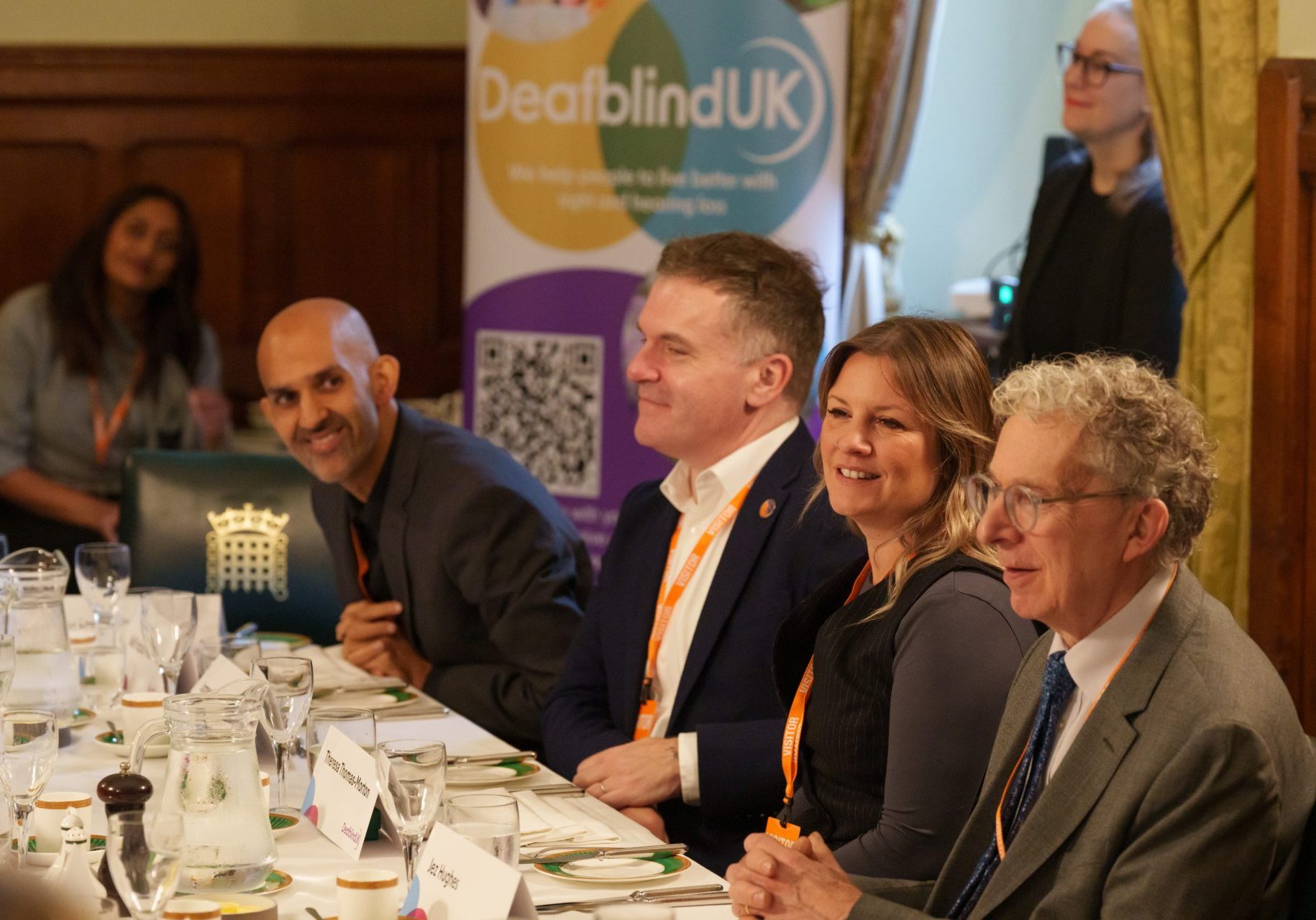
Deafblind UK has hosted the first in a new annual series of high-level roundtable events at the House of Commons, bringing together parliamentarians, sector leaders and people with lived experience to focus on one shared goal: ensuring that everyone who is deafblind can access the services and support they need to live well.
The roundtable created a rare space for open, practical discussion about how deafblind people experience services across health, social care, education and employment – and where systems are currently falling short.
Key themes emerging from the discussion included the urgent need for joined-up policy, early identification and intervention, improved professional training, and stronger recognition of deafblindness as a distinct disability requiring specialist pathways – not generic or single-sensory services.
Participants also emphasised the importance of partnership working, stronger data and research, and ensuring that deafblind people themselves are involved at every level of decision-making – from policy development to service design and delivery.
The event, hosted by Andrew Pakes MP, brought together a wide range of voices from across the sector, alongside Sir Stephen Timms MP, Minister for Social Security and Disability, who joined the discussion to hear first-hand about the barriers deafblind people face and to take questions on current Government plans.
Central to the conversation was the importance of moving beyond discussion to delivery. The event concluded with a shared commitment to work collaboratively towards a national benchmark for deafblind inclusion, strengthen representation of deafblind people in policymaking, and use this annual House of Commons roundtable as a platform to track progress and accountability.
The discussions also reinforced the scale of the challenge: more than 450,000 people in the UK live with deafblindness, yet access to support varies dramatically depending on where people live. Participants highlighted the fragmentation families face, the lack of consistent data, and the absence of deafblind voices in many national advisory structures – all of which contribute to inequality in outcomes and opportunity.
Deafblind UK described the event as a powerful starting point for long-term change, bringing together policy, practice and lived experience in one room. By creating space for honest conversation, shared learning and collective ambition, the roundtable marked the beginning of a coordinated national effort to ensure deafblind people are no longer overlooked in policy, planning and provision, and to build a future where people with dual sensory loss across the UK can access the support, dignity and opportunities they deserve.
Update (04 February 2026): A post-Roundtable briefing can now be accessed in our document Deafblindness in the UK: National Benchmark for Action.