
Skip to content
  • Play Our Lottery
  • News
  • Blog
  • Stories
  • Events
  • Contact Us
  • Donate
Deafblind UK
Call us on: 0800 132320 Email us on: [email protected]
Deafblind UK
  • Get Support
    • Practical Support

      Support with everyday activities like shopping or catching up with friends.

    • Emotional Support

      Feeling overwhelmed, lonely or just need to talk? We’re here for you.

    • Information and advice

      Find out more about sight and hearing loss.

    • Help with Technology

      From smartphones to listening aids, let digital tech help you connect.

    • Holidays

      Discounted holidays in Norfolk.

    • Become a member

      Access our support with a free membership to Deafblind UK.

    • Find a service near you

      Use our search tool to find deafblind friendly groups, activities and venues near you.

  • Get Involved
    • Our campaigns

      Our latest campaigns to raise awareness of deafblindness.

    • Events and challenges

      Challenge yourself to raise money for people with sight and hearing loss.

    • Volunteer

      Find out about volunteering for Deafblind UK.

    • Our shops

      Our charity shops sell clothes, homeware, books, games and much more!

    • Play our lottery

      Find out about our weekly Deafblind UK lottery draw and start playing now.

    • Corporate partners

      Find out how we work with corporate organisations to lead social change.

    • Give in memory

      Make a donation to celebrate the life of a loved one.

    • Leave a gift in your will

      Find out how your can leave a legacy gift to Deafblind UK

  • For Professionals
    • Learning and development

      Webinars and courses for anyone who works with people who are deafblind.

    • Becoming Deafblind friendly

      Could your service, business or venue be more accessible to people with sight and hearing loss?

    • Deafblind awareness talks

      Find out more about sensory loss by booking a deafblind awareness talk for your team.

    • Schools

      Together we are creating great memories for young deafblind people!

    • Resources

      A range of fact sheets, guides and information to download.

    • Make a referral

      Refer someone to us for help and support.

    • Payroll giving for employers

      You can create a brighter future for people who are deafblind with Payroll Giving.

  • About Us
    • Join our team

      Check out our available jobs and come and work for us!

    • Our people

      Meet our Board and Executive Management Team.

    • Impact report

      Download our most recent impact report.

    • Our Vision and Strategy

      Find out why were here and what we stand for.

    • Our history

      Discover our rich history of helping people with sight and hearing loss.

    • Research

      Read about our current research projects.

  • Get Support
    • Practical Support

      Support with everyday activities like shopping or catching up with friends.

    • Emotional Support

      Feeling overwhelmed, lonely or just need to talk? We’re here for you.

    • Information and advice

      Find out more about sight and hearing loss.

    • Help with Technology

      From smartphones to listening aids, let digital tech help you connect.

    • Holidays

      Discounted holidays in Norfolk.

    • Become a member

      Access our support with a free membership to Deafblind UK.

    • Find a service near you

      Use our search tool to find deafblind friendly groups, activities and venues near you.

  • Get Involved
    • Our campaigns

      Our latest campaigns to raise awareness of deafblindness.

    • Events and challenges

      Challenge yourself to raise money for people with sight and hearing loss.

    • Volunteer

      Find out about volunteering for Deafblind UK.

    • Our shops

      Our charity shops sell clothes, homeware, books, games and much more!

    • Play our lottery

      Find out about our weekly Deafblind UK lottery draw and start playing now.

    • Corporate partners

      Find out how we work with corporate organisations to lead social change.

    • Give in memory

      Make a donation to celebrate the life of a loved one.

    • Leave a gift in your will

      Find out how your can leave a legacy gift to Deafblind UK

  • For Professionals
    • Learning and development

      Webinars and courses for anyone who works with people who are deafblind.

    • Becoming Deafblind friendly

      Could your service, business or venue be more accessible to people with sight and hearing loss?

    • Deafblind awareness talks

      Find out more about sensory loss by booking a deafblind awareness talk for your team.

    • Schools

      Together we are creating great memories for young deafblind people!

    • Resources

      A range of fact sheets, guides and information to download.

    • Make a referral

      Refer someone to us for help and support.

    • Payroll giving for employers

      You can create a brighter future for people who are deafblind with Payroll Giving.

  • About Us
    • Join our team

      Check out our available jobs and come and work for us!

    • Our people

      Meet our Board and Executive Management Team.

    • Impact report

      Download our most recent impact report.

    • Our Vision and Strategy

      Find out why were here and what we stand for.

    • Our history

      Discover our rich history of helping people with sight and hearing loss.

    • Research

      Read about our current research projects.

Communication

There are many different ways that people who are deafblind communicate, rather than one standard method. The way that you communicate is likely to depend on your personal preference and whether you have acquired your sensory loss or whether you were born with it. Many people who become deafblind over time prefer to adapt the way they are used to communicating, rather than learning a new method.

Non-verbal communications

Only 7% of communication is verbal, so we rely heavily on body language and tone of voice to gather additional information. Facial expressions, hand gestures, body language and vocal variety give us much more information than words alone.

So, even though you may understand what is being communicated, you may find that you miss the emotion, severity and other complexities of the conversation.

Receiving and expressing

Some people who are deafblind prefer to receive information in one way and express information in a different way. For example, if you have acquired sight and hearing loss over time then you may be able to talk perfectly well as you have been doing this since a very young age. However, you may not be able to hear well enough to take information in, so you might prefer to receive information by lip reading or using deafblind manual.


Some common communication methods are:

Speech

Many people who are deafblind can talk and can hear clear speech. This is because you probably learned to talk before your sight and hearing deteriorated. Advances in technology mean that those who would have previously relied on lip reading can now hear through hearing aids and portable listening devices. You may find it useful to use a combination of speech and lip reading, although this often becomes difficult when there is more than one person talking or when there is background noise.


Lip reading

Lip reading is a method of identifying words by watching the shape of someone’s mouth when they talk. It is often used alongside speech; you may be able to pick up words that you don’t hear by lip reading and your brain will make adjustments. If you lip read, remember to ask people to keep their hands away from their mouths when they talk and to stand where you can see them.


British Sign Language (BSL)

BSL is a visual communications method that uses hand gestures instead of spoken words. If you were born deaf then it is likely that you learned BSL as your first language. To use BSL you need to be able to see the other person’s hands, this means that it can difficult to communicate in certain situations, or if you have low vision. If you use BSL and your sight worsens then you may want to use tactile sign language or ‘Hands On’ BSL which involves you feeling the movements of the signers hands.


Signed English

Signed English borrows signs from BSL, but uses the grammar and sentence structure of the English language. Signed English was developed by teachers of the deaf and other professionals to assist in the English literacy development of deaf (sign language using) children.


Makaton or Key Word Signing

Makaton is another visual language using signs and symbols. It is designed to support spoken language and the signs and symbols are used with speech, in spoken word order. It is often used with children and adults with learning disabilities as a simplified and accessible signed communication.


Visual frame signing

If you have a reduced field of vision then you might find visual frame signing is useful. This is where your communication partner signs (using BSL or another form of sign language) within a smaller area to ensure all of their signs stay within your field of vision.


Deafblind Manual

Deafblind manual is a tactile communications method where individual letters are signed onto your hand so that you can spell words. This is often used by people who have little or no sight or hearing. It is very easy to learn – download our poster and have a go yourself  or click here to watch a video of Deafblind Manual. 


Block

Probably the easiest deafblind tactile language to express – the block alphabet uses English capital letters, drawn onto your palm.


Braille

Braille is a tactile writing system originally developed with embossed paper, but now accessible through refreshable braille displays. Each letter is symbolised by a series of raised dots that you can feel with your fingertips.


Tracking

If you have some usable vision then you may want to follow signs by holding the signer’s forearm or wrist and using your eyes to follow the signs visually. Having the connection of using vision and touch together means the signs stay within your visual frame and are effectively ‘tracked’.


Hands on Signing/ Co-active Signing

Hands on signing is a tactile derivative of BSL where you gently place your hands on top of your communication partner’s hands to feel the movements of the signs. This may sound complicated but the more you practice, the less you will have to think about it. Click here to watch a video of hands on signing. 


Tadoma

Tadoma is a way of receiving communication by placing your hands on someone’s throat, lips or cheeks. Practised users will be able to identify words by feeling lip movements and vibrations. Click here to read about how Christine uses Tadoma.


Moon

Moon is another tactile writing system which is rarely used these days. Its patterns follow a more visually recognisable English letter formation, instead of dots, as braille does.


Objects of reference

This is less of a communication system and more of a means to refer to an activity or event. Objects of reference can be really helpful in developing language. For example, a parent of a deafblind child may use a sponge to tell their child that it’s bath time. Later that child may develop the understanding that sponge means bath but flannel means shower. The parent can then offer a choice; flannel (shower) or sponge (bath). Click here to read how Helen Keller used objects of reference as a young girl.


Print this Page

Get in touch to find out more

This field is for validation purposes and should be left unchanged.
Name
Your privacy(Required)
< Back to previous page

Share this page:

Share on X (Twitter) Share on Facebook Share on Pinterest Share on E-mail Share on WhatsApp
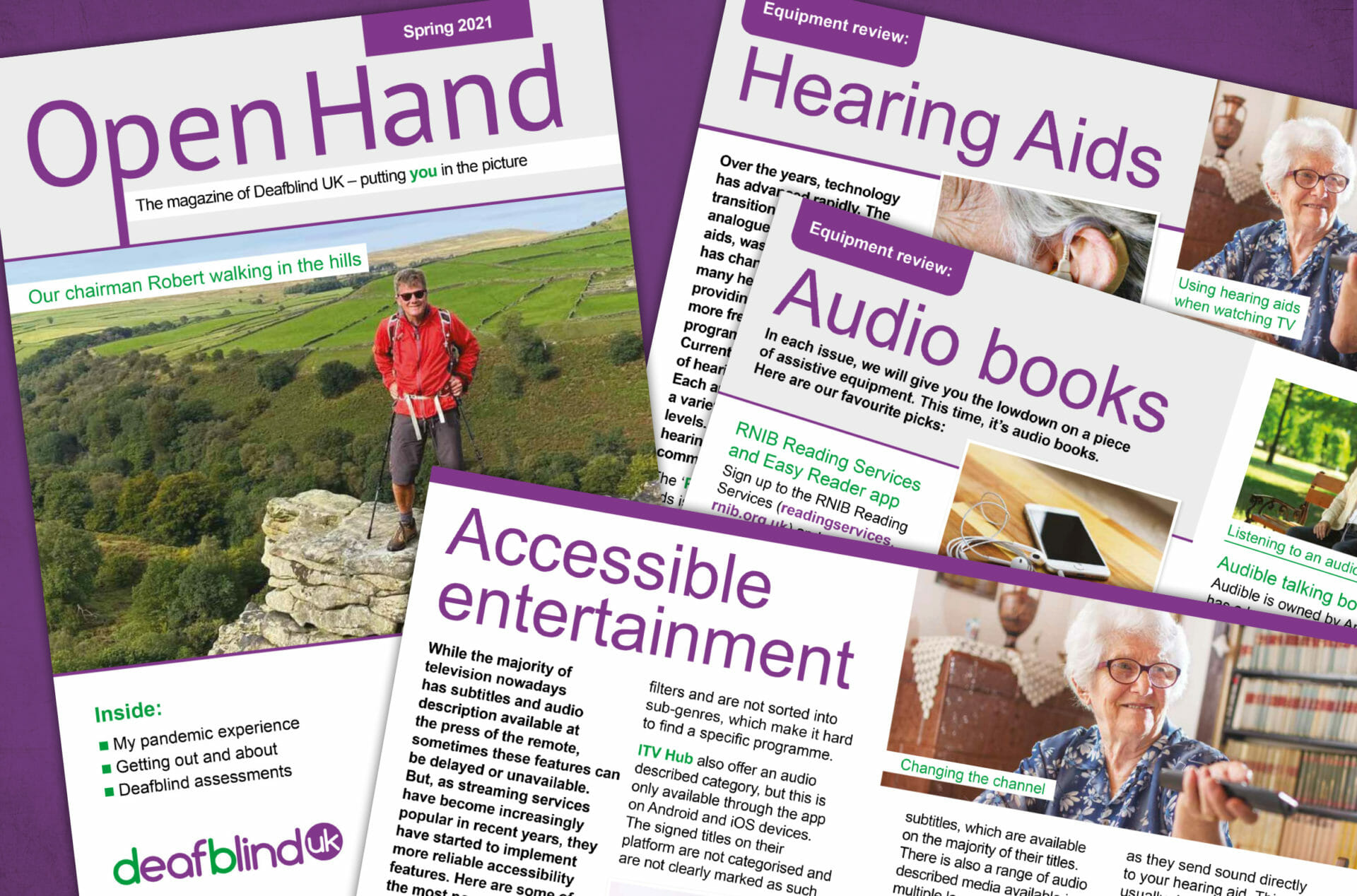
Image of Open Hand Magazine

Open Hand Magazine

Open Hand is our quarterly magazine. It contains articles and information that are tailored specifically to people with dual sensory…

Find out more

Let’s keep in touch!

Join our mailing list and we will keep you up to date about our projects and opportunities to get involved with Deafblind UK.

Join the mailing list

Open Hand Magazine

Open Hand is our free, quarterly magazine containing articles and information that are tailored specifically to people with dual sensory loss.

There are very few publications designed for this specific market and so Open Hand gives its readers valuable information that they may not otherwise have known and reminds readers about Deafblind UK’s support services.

Find out more

Prefer to talk?

Call us on 0800 132320 or text us 07903572885
Monday – Thursday 9.00am – 5.00pm and Fridays 9.00am – 4.00pm

Join our mailing list for regular updates

We would love to keep in touch with you to keep you up to date about our work.

Join the mailing list

Support our work and make a difference:

Donate Donate
db-logo-white

National Centre for Deafblindness
167-169 Great Portland Street
5th Floor
London
W1W 5PF

Tel/Textphone: 01733 358 100

© 2023 Deafblind UK · Registered Charity No: 802976 • Company Reg No: 2426281

Privacy Notice · Cookie Policy

Timeweb Employee Login

Follow Us

Facebook

Twitter

YouTube

Instagram

Fundraising Regulator badge with validation link
Deafblind UK
Call us on: 0800 132320 Email us on: [email protected]
  • Home
  • Get Support
    • Practical Support
    • Emotional Support
    • Information and advice
    • Help with Technology
    • Holidays
    • Become a member
    • Find a service near you
  • About Us
  • Get Involved
    • Our campaigns
    • Events and Challenges
    • Volunteer
    • Our shops
    • Play our lottery
    • Corporate partners
    • Give in memory
    • Leave a gift in your will
  • For Professionals
    • Learning and development
    • Resources
    • Becoming deafblind friendly
    • Deafblind awareness talks
    • Support for schools, colleges and universities
    • Make a referral
    • Payroll giving for employers
  • About Us
    • Join our team
    • Our People
    • Impact Report
    • Our Vision and Strategy
    • Our strategy
    • Our history
  • News
  • Blog
  • Stories
  • Events
  • Donate
  • Contact Us
Manage Cookie Consent
We use cookies to optimise our website and our service.
Functional Always active
The technical storage or access is strictly necessary for the legitimate purpose of enabling the use of a specific service explicitly requested by the subscriber or user, or for the sole purpose of carrying out the transmission of a communication over an electronic communications network.
Preferences
The technical storage or access is necessary for the legitimate purpose of storing preferences that are not requested by the subscriber or user.
Statistics
The technical storage or access that is used exclusively for statistical purposes. The technical storage or access that is used exclusively for anonymous statistical purposes. Without a subpoena, voluntary compliance on the part of your Internet Service Provider, or additional records from a third party, information stored or retrieved for this purpose alone cannot usually be used to identify you.
Marketing
The technical storage or access is required to create user profiles to send advertising, or to track the user on a website or across several websites for similar marketing purposes.
  • Manage options
  • Manage services
  • Manage {vendor_count} vendors
  • Read more about these purposes
Preferences
  • {title}
  • {title}
  • {title}